
How can hands-on therapy help with coccyx pain?
If you have tailbone pain, you might be wondering:
“Can hands-on therapy actually help?”
“Is someone just going to press on the sore spot?”
“Why does it hurt when I sit down?”
Coccyx (tailbone) pain can feel confusing and frustrating. Hands-on therapy, sometimes referred to as ‘manual therapy’, can be one part of treatment for coccyx pain. Below is an explanation of how hands-on therapy may help, and why tailbone pain is rarely just about the coccyx bone itself.
What is the coccyx? (A quick reminder)
The coccyx is the small bone at the very bottom of the spine. It sits between your two “sit bones.”
It connects to:
The pelvic floor muscles
The gluteal (bottom) muscles
Strong ligaments
The sacrum (the bone just above it)
The coccyx helps distribute weight through your pelvis when you sit. It is part of a bigger system that includes muscles, joints, and nerves in the pelvis, meaning that coccyx pain is about more than just the bone itself. You can read more about the coccyx and your pelvic floor here.
How does hands-on therapy help?
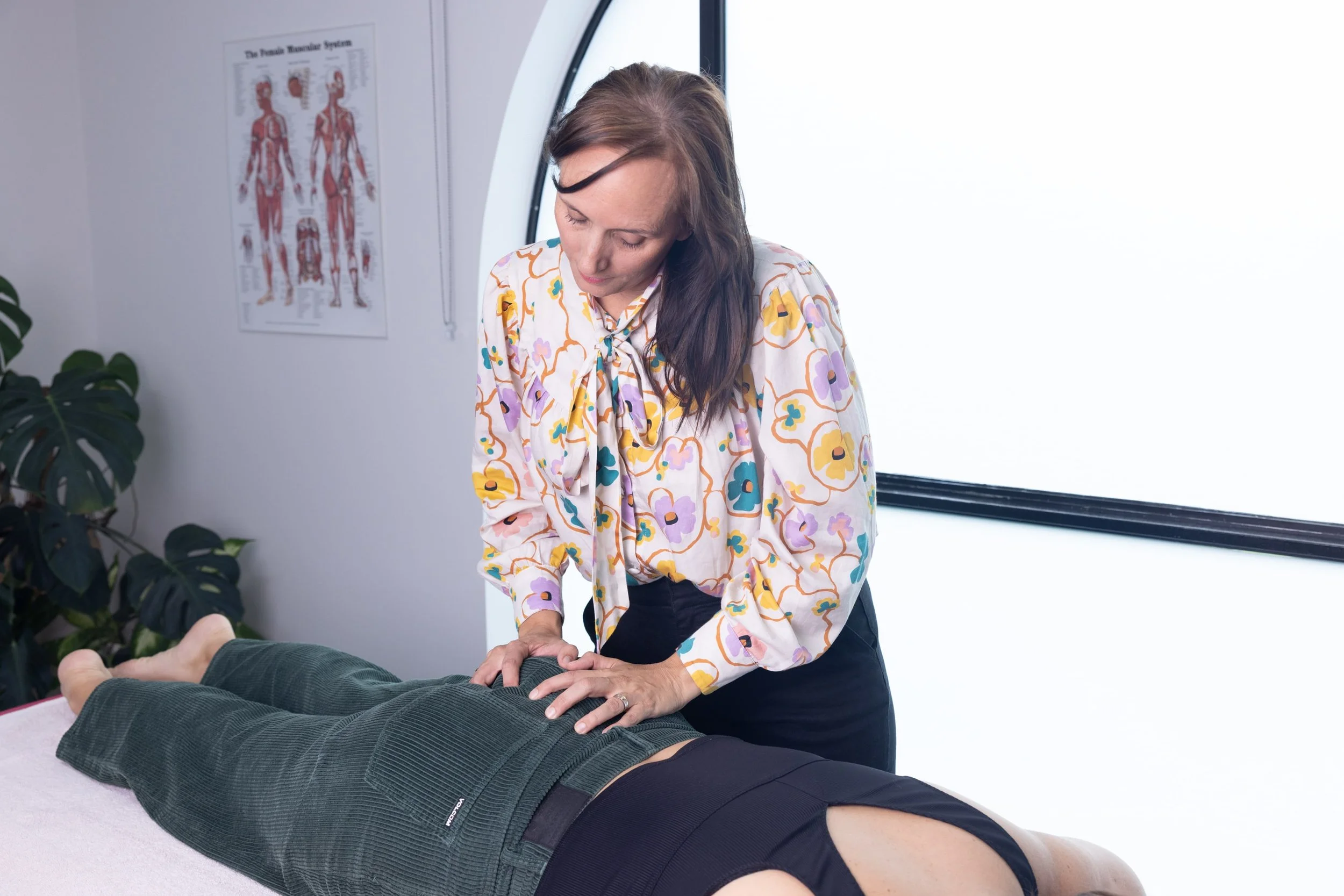
For some people hands-on therapy (manual therapy) can be a helpful part of managing coccyx pain, because it can:
Reduce muscle tension
Improve joint movement
Support circulation
Reduce the effect of load and posture on the coccyx
Support the nervous system to reduce pain
Manual therapy is not about “pushing bones back into place.” It is about understanding the forces going through the coccyx bone and why it is not able to manage those forces. The reasons you have coccyx pain are unique to you and working with a practitioner who understands how to treat coccyx pain may be helpful in treating your coccyx pain.
Hands on therapy for coccyx pain can:
1. Reduce muscle tension
One common cause of coccyx pain is tight or overactive muscles around the area.
This may include:
The pelvic floor
The deep hip muscles
The gluteal muscles
The lower back muscles
When these muscles are holding extra tension, they can pull on the coccyx. This may create pressure, aching, or sharp pain in the coccyx when doing things like sitting.
Hands-on techniques such as gentle soft tissue work may help the body reduce this tension. This is not about forcing muscles to relax. It is about helping the nervous system feel safe enough to let go of extra guarding.
For some people, this can reduce pressure on the tailbone and improve comfort.
2. Improve joint movement
The coccyx connects to the sacrum at a small joint. Like other joints in the body, it has a small amount of movement.
If the coccyx joint, or the joints around it, are not moving well, the body may change how it shares load throughout the pelvis. Over time, this can add strain to the area.
Gentle hands-on techniques may help improve movement in:
The coccyx
The sacrum
The pelvis
The lower back
Better movement can sometimes make everyday activities like sitting and standing more comfortable.
Direct Coccyx manipulation
In some cases, especially after a fall or birth, the coccyx may be held in a position that contributes to discomfort.
As practitioners trained in coccyx pain, we can assess this carefully. If appropriate, gentle external techniques — and sometimes internal techniques — may be applied directly to the coccyx.
Please note: Internal coccyx techniques are always optional and explained clearly beforehand. They are not needed for everyone and it is always your choice if you receive them.
3. Support circulation
Hands-on therapy can also increase blood flow to an area.
Healthy blood flow may:
Support tissue repair
Help settle irritation
Improve tissue health
In some cases, especially after a fall or long periods of pressure, this may support recovery.
4. Reduce the effect of load and posture on the coccyx
Coccyx pain often feels worse when sitting, although this varies from person to person. However, this pain is not usually about “bad posture” alone, it is more about how weight is distributed throughout the pelvis.
If more weight is going through the coccyx instead of the sit bones, the coccyx can become irritated. Muscle or ligament tension can also pull the coccyx slightly to one side, which may increase pressure.
As Osteopaths, we look at:
How you sit
How you move from sitting to standing
How your pelvis moves with the rest of your body
How you breathe
Reducing tension in areas of tension can lead to changes in movement or positioning, which can reduce stress on the cocccyx and reduce pain.
5. Support the nervous system to reduce pain
Pain is not just about muscles, bones and ligaments. The nervous system also plays a big role.
If an area has been painful for a while, the nervous system can become more protective. This may lead to:
Muscle guarding
Increased sensitivity
Pain with light pressure
Hands-on therapy provides safe, gentle input to the area. This may help the nervous system feel safer and reduce how much protection it is using.
Sometimes the body continues to guard long after the original problem has improved. Hands-on therapy may be helpful for some people to reduce this protective response.
Hands-on therapy is only part of the picture
Hands-on therapy is usually just one part of treatment for coccyx pain. We see a lot of people with coccyx pain and we’re here to share our knowledge of what may be useful. As you’re probably already aware, what works for one person may not work for someone else, but we can help guide you to find what works for you.
We also find that treatment should also include movement advice, breathing awareness, pelvic floor education and a whole range of other things that are unique to you.
If you would like to read more about manual approaches to coccyx treatment, this independent resource has some useful information: https://www.coccyx.org/treatmen/manual.htm
Do you want to try manual therapy for your coccyx pain?
If your coccyx pain has been lingering, or you are unsure why it started, hands-on therapy may be helpful for you.
We are passionate about treating coccyx pain. If you would like to explore an individual approach, consider booking in with one of our team.
Remember, coccyx pain can be complex, but complex does not mean nothing can help.

Disclaimer: This blog is for general informational purposes only and does not constitute the practice of medicine, osteopathy, nursing or other professional health care services, including the giving of medical advice, and no practitioner/patient relationship is formed. The use of information on this blog or materials linked from this blog is at the user's own risk. The content of this blog is not intended to be a substitute for professional medical advice, diagnosis, or treatment. Users should not disregard, or delay in obtaining, medical advice for any medical condition they may have, and should seek the assistance of their health care professionals for any such conditions.